
JAPANESE KNOTWEED REMOVAL Whitehaven
5
LIVE KNOTWEED JOBS IN Whitehaven
22
SUCCESSFUL KNOTWEED REMOVAL PROJECTS IN Whitehaven
100%
SUCCESSFUL PROPERTY SALES AFTER TREATMENT
8
Whitehaven BASED KNOTWEED STAFF
Japanese Knotweed control Whitehaven
Our specialist teams of qualified surveyors travel throughout Whitehaven to provide advice, assistance, and solutions for your Japanese knotweed problems. We offer efficiency, reliability, and value with our tailored solutions for all your Japanese knotweed needs.
The PCA is a government-approved trade body for “the damp, waterproofing and wood preservation industries.” Any PCA member will be able to give you the best advice and guidance on controlling and eradicating Japanese knotweed.
We have used our expertise in knotweed eradication to complete a number of challenging projects in and around Whitehaven and England. For knotweed removal to be successful, experienced identification, surveying, treatment, and control must take place. We can help.
Japanese Knotweed Whitehaven – All You Need to Know
Japanese knotweed is one of the most damaging plants in the UK and indeed is rife in Cumbria. Where it exists, the value of your property can drop by thousands – or even tens of thousands – of pounds. Wherever you are in the UK, we offer a free survey to discover whether you have knotweed on your property and how best to manage it.
Knotweed Services offers a variety of services for commercial land and property owners that deal with the removal and eradication of Japanese knotweed.
How bad is Japanese Knotweed?
- Japanese knotweed can grow through tarmac or concrete, threatening the stability of building foundations.
- Mortgage lenders often refuse to lend against a building that has Japanese Knotweed growing on it.
- Knotweed obstructs access to infrastructure, including roads and rivers. It can cause major disruption in commercial areas.
If you live in Whitehaven and have knotweed, you should call Knotweed Services first. Our licensed specialists will remove the knotweed completely and guarantee that it will not return. We will also dispose of the removed plant material legally.


FREE IDENTIFICATION
Fill in the form below, attach your pictures and we’ll let you know if the plant in your picture is Japanese Knotweed.
Call our experts ASAP to start the treatment and control of your infestation in Whitehaven
Call us on: 0121 725 6348 or 0800 689 4146 for an swift idea on cost
Knotweed Services will guide you through the process from the point of initial contact until we handle everything for you.
RESIDENTIAL JAPANESE KNOTWEED REMOVAL Whitehaven.
WHAT YOU NEED TO KNOW ABOUT JAPANESE KNOTWEED REMOVAL Whitehaven
Because Japanese knotweed infestations can vary considerably from property to property, it’s not surprising that treatment and control will too. It may be necessary to use one method or a combination of different knotweed removal methods.
We take a scientific approach to weed control. Our weed specialists examine a site’s specific factors to determine the type of treatments that will give the best results. We guarantee all our work.
— JAPANESE KNOTWEED REMOVAL OPTIONS AVAILABLE IN Whitehaven

FOLIAR SPRAYING *
Most common treatment. The spraying of powerful chemicals with a knapsack. We ensure that other plants aren’t damaged. The most effective time for foliar spraying to Japanese Knotweed is in Spring

FOLIAR LEAF WIPING *
With this Japanese knotweed treatment we employ a device to ‘physically wipe’ our chemicals onto the Japanese Knotweed leaves. This application is so precise that we can often use a higher concentration of chemical.

STEM INJECTION
We apply a controlled amount of herbicide directly into the invasive weed. Due to being injected directly into the Japanese Knotweed, this is the most crafty method of removal. It isn’t dependent on the weather.

BIOMASS REDUCTION
Biomass is a form of excavation and removal but instead of extracting all of the soil impacted by Japanese Knotweed, we only remove the infested parts of the soil. It’s an excellent Japanese Knotweed control method that allows the reuse of the soil. Reducing the use of landfill.

CROWN REMOVAL
Crown and stems are capable of regenerating and even small fragments of cut crown or stem are capable of regenerating and becoming a new invasive weed – removing these from the equation is a great strategy.
— COMMERCIAL TREATMENT OPTIONS AVAILABLE IN Whitehaven
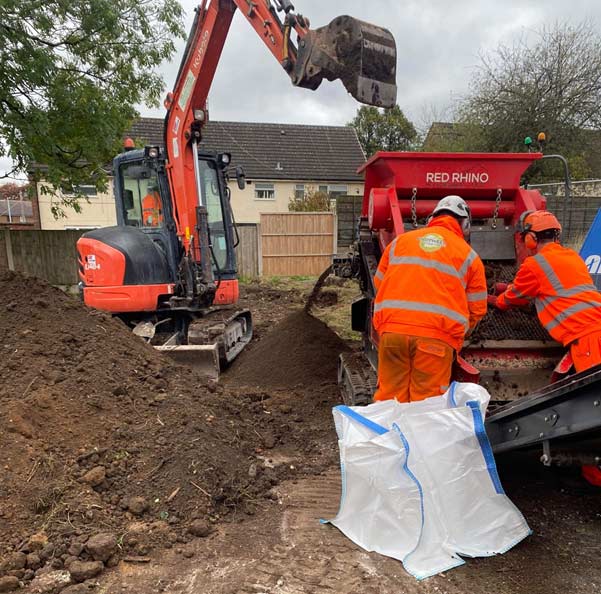
SOIL SCREENING
A tried and tested methodology used on hundreds of sites across the UK.
Using the screening method, the Japanese knotweed rhizome material is separated from the soil material. The Japanese knotweed material is then either transported to licensed landfill at a much lower disposal rate or incinerated on site using a D6 exemption from the Environment Agency or Natural Resources Wales.
The cleaned soils can then be reused in locations away from any construction, normally in soft landscaping areas.
This can reduce the landfill & backfill requirement costs significantly and can also help to reduce the carbon footprint on site due to reduced vehicle movements to landfill.

BIOSECURITY SUPERVISION
Knotweed Services can provide a biosecurity operative to supervise any excavations and movement of soils containing Japanese knotweed on site.
As part of these measures, we can provide a biosecurity boot wash and machine-washing area installed in an area at the entrance to the site.
We will provide all toolbox talks for the main contractor on site, which will be signed by all contractors involved in the operation on site.
We can provide temporary geotextile barriers if required in areas to maintain the biosecurity on site.
Once the works have been completed, we will provide the client with a full biosecurity report.
This method can be used in conjunction with other treatment methods on site.

EXCAVATION AND DISPOSAL
This treatment method is ideal where time constraints are present and there’s no other option other than to remove both the Japanese Knotweed and contaminated soil to a registered landfill.
By removing all traces of the infestation quickly, this offers a rapid solution to your problem and allows your commercial project to begin groundwork’s almost straight away. When time is of the essence, there is no quicker Japanese Knotweed removal/treatment method.
Any waste taken off-site will be done so with a licensed waste carrier to a suitably authorised landfill site.

CELL BURIAL
Cell burial comprises of moving Knotweed contaminated soil from one location on site, burying it in an excavated pit which is lined with a root barrier membrane, in a different position on the site.
The burial requirements for Japanese Knotweed are as follows:
- The Environment Agency recommends that the top of the burial cell should be a minimum of 2 metres below ground level.
- The overall depth of the burial pit should be in excess of 5 metres deep. All root barrier seams are welded together forming an encapsulated cell from which the Japanese Knotweed cannot escape. Clean soil is then used to backfill on top of the cell.
- To prevent accidental disturbance of the burial site, it is recorded on all site plans and future land owners should be made aware of the location.

STOCKPILE & TREAT
Bunding is the method of relocating contaminated Japanese Knotweed soil to a different area of the site being treated. A bund is a shallow area of the contaminated soil, typically 0.5m deep.
The bund can either be raised, on top of the ground, or placed within an excavation to make the surface flush with the surrounding area.
The purpose of the bund is to move the Japanese Knotweed to an area of the site that is not used. This ‘buys time’ for treatment that would not be possible where the Japanese Knotweed was originally located.

HERBICIDE APPLICATION
At Knotweed Services we can provide the client with bespoke treatment plans depending on the locations of the Japanese knotweed.
These plans can work in conjunction with other methods of treatment where access is limited to pedestrian movements i.e., embankments or existing pathways within a site.
This will normally consist of up to 3 visits per annum to apply herbicide by either foliar spray technique or stem injection during the growing season over a period of 3 years, with a monitoring period of 2 years thereafter.
We would select the appropriate herbicides depending on the surrounding foliage or environmental constraints.
After each visit a full treatment record would be provided with photos showing the progress of the works and then an annual report.