
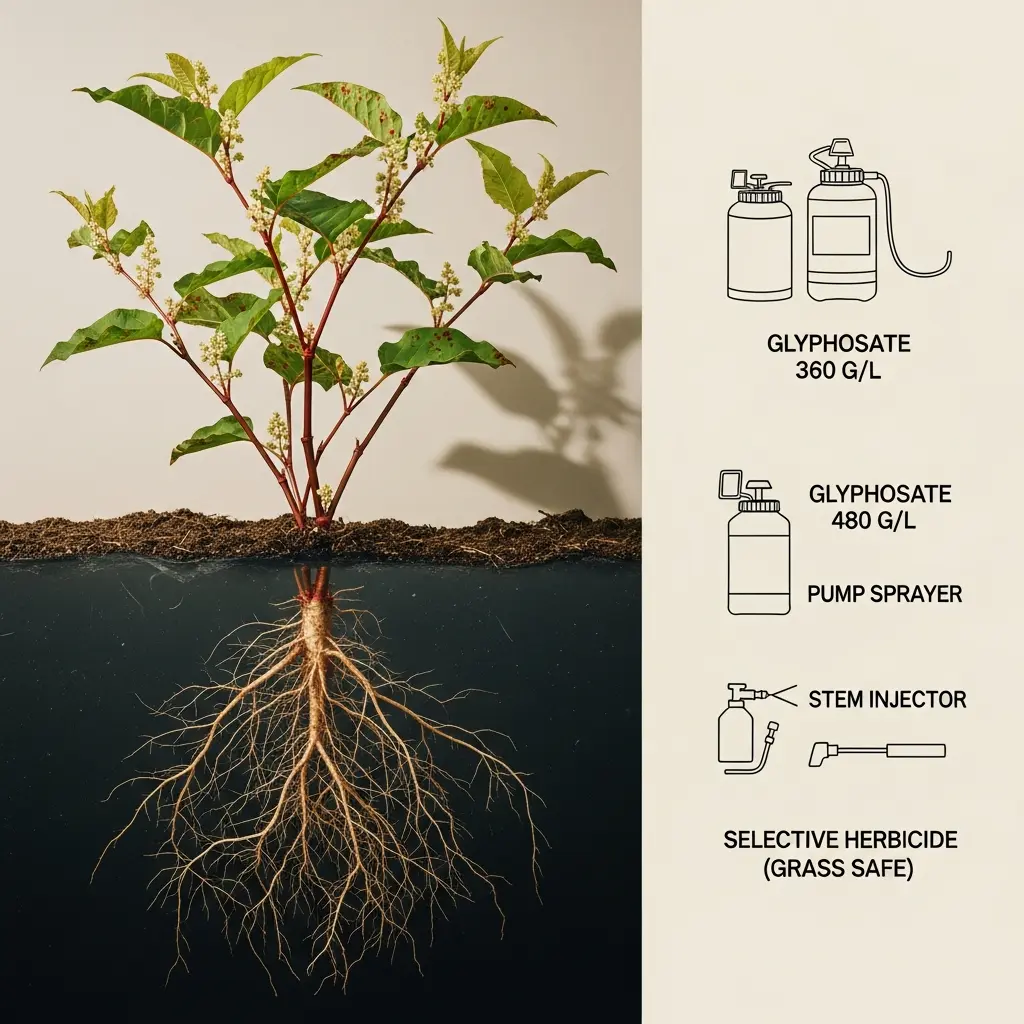
If you are searching for the best weedkiller for Japanese Knotweed, you are likely dealing with a persistent, established infestation that has begun to spread across your land, garden, or a problem area close to a property boundary.
Japanese Knotweed is not like most other weeds you may find growing in your garden. It is an invasive species in the UK, and it has an underground network of rhizomes that allows it to spread over a large area. It can regrow from very small fragments of root material or stem left in the soil, which is why quick fixes and surface-only weed killers rarely work long term.
This Guide identifies effective treatments for Japanese Knotweed (Knotweed), identifies common methods/products used by contractors, discusses timing issues in dealing with Knotweed, and outlines your obligations as a property owner when Japanese Knotweed is identified on your property.
It is acceptable to grow Japanese Knotweed on your land; however, it is illegal to allow Japanese Knotweed to escape from your land and become a weed species in the wild or on adjacent lands.
If the need exists for structurally identifying or managing Japanese Knotweed, Knotweed Services offers identification services along with UK-wide compliance based treatment planning.
For a broader overview of all treatment routes and legal considerations, see our full guide on how to kill Japanese knotweed.
Introduction to Invasive Plants
In the UK, invasive plants are becoming an increasingly serious issue, with Japanese Knotweed being one of the worst offenders.
It is an aggressive weed that is difficult to eradicate due to its ability to rapidly grow and outcompete all other vegetation in the area, causing disruption to the ecosystem in the process and also creating problems for landowners.
Controlling Japanese Knotweed does require more than simply treating the plant once. It requires long-term management, follow-up treatments, and continued efforts to prevent the spread of the plant.
Understanding the risks associated with invasive plants such as Japanese Knotweed and taking action to manage the spread of these plants from an early stage will allow landowners to protect their land and ultimately protect the value of their property and preserve native biodiversity.
Find out more about Schedule 9 Invasive Species.
Table of Contents
Why Japanese Knotweed Is So Difficult to Kill
Japanese Knotweed is a perennial plant that grows each year from extensive underground rhizomes. These rhizomes store energy and drive regrowth even after the visible stems die back.
The rhizomes of Japanese Knotweed can grow up to 20cm a day in peak growth and can reach depths of 3m in soil. That combination of speed and depth makes it difficult to control with light herbicide use or shallow digging.
Fleshy, red shoots appear in early spring and can reach 1.5m by May and 3m by June. Rapid spring growth often convinces property owners that a single treatment should “do the job”, but the rhizomes underneath usually remain viable.
How Japanese Knotweed Spreads Across Sites
The primary mechanism by which Japanese Knotweed is dispersed is through fragments of either the rhizome or stem. These can be easily moved to other locations. Many examples of how this occurs include:
- Movement of contaminated soil (for example, through digging for foundations, landscaping, etc.)
- Incorrect disposal of cut stems.
- Fly-tipping or unauthorised removal and disposal.
- Movement of machinery that has been in contact with stems, and is then moved to a different part of the site.
Japanese Knotweed rarely produces fertile seed in the UK, although it may hybridise with other species to some extent. Therefore, most of the dispersal of Japanese Knotweed occurs through human activities rather than through the production of fertile seed.
It will thrive in almost all soil types commonly found in the UK. The majority of its growth tends to occur in artificial environments such as those near railways, on brownfield land, demolition sites and where the ground has been previously disturbed.
The Importance of Early Action
Taking timely action is important in addressing invasive plants. Early detection and treatment of Knotweed will also help to make its management simpler and reduce the possibility of it establishing on adjacent properties.
With prompt identification and treatment of Knotweed, there is greater potential to effectively apply treatments (such as foliar spray and/or stem injection) prior to the plant being fully established.
Treatment at an early stage minimises the risk of regrowth. It minimises the chance of the plant damaging surrounding property or infrastructure. Monitoring for new shoots/growth, and taking swift action if identified, will help to limit Knotweed from developing into a large-scale and costly infestation.
By acting promptly, you may be able to reduce the risks to your property and possibly eliminate the complexities associated with a widespread infestation.
Why It Matters for Buildings and Infrastructure
Left unmanaged, Japanese Knotweed can form dense stands that outcompete native vegetation and cause structural damage.
It can exploit weaknesses in foundations and underground structures if left untreated, including cracks in hardstanding, retaining walls, and drains. While it does not “drill through concrete”, it can take advantage of existing weaknesses, and it can become a serious nuisance if it spreads.
Ignoring Japanese Knotweed can lead to structural damage to buildings and infrastructure, especially where the infestation is left to expand over several growing seasons.
What Kills Japanese Knotweed Permanently?
There is no single spray or one-off product that will permanently eradicate Japanese Knotweed in one application.
Eradication of Japanese Knotweed typically requires annual treatments for two to five years. It typically takes at least three years of repeated glyphosate application to eradicate established Japanese Knotweed fully.
To achieve the best results, it is essential to carefully select the appropriate herbicide, use correct application methods, and maintain consistent follow-up treatments.
A reliable outcome depends on:
- Using the correct type of herbicide (systemic, not contact)
- Applying the correct concentration
- Choosing the correct method
- Applying at the right time of year
- Completing follow up treatment and monitoring
This is why professional management programmes will almost always outperform isolated DIY attempts.
Glyphosate-Based Herbicides Are the Main Option
Glyphosate-based herbicides are the most effective over-the-counter treatments for Japanese Knotweed. However, most products available from garden centres are not strong enough to rid properties of Japanese Knotweed, and professional-grade herbicides are usually required.
Systemic herbicides with high concentrations of glyphosate are the most effective weedkillers for treating Japanese Knotweed because they move through the plant.
The plant’s foliage absorbs these systemic herbicides into its stems. They are transported throughout the plant into the rhizomes and roots. That transport into the rhizomes is the key difference between killing top growth and achieving long-term control.
For a detailed breakdown of concentrations, application timing and professional use, read our guide on Japanese knotweed glyphosate treatment.
The Glyphosate Concentration That Actually Matters
The glyphosate concentration in professional products is typically 360 g/L or 480 g/L.
Examples commonly referenced include:
- Roundup ProActive Concentrated Glyphosate Total Weed Killer contains 360 g/L of glyphosate.
- Roundup ProVantage 480 Concentrated Glyphosate Total Weed Killer contains 480 g/L of glyphosate and is often used by professionals.
- Barclays Gallup Hi-Aktiv Weed Killer contains 490 g/L of glyphosate and is noted for its effectiveness on tough weeds.
Professional-strength herbicide products are generally required for effective treatment of Japanese Knotweed, particularly where growth is mature, dense, or has already regrown after cutting.
Why Over-Application Can Make Treatment Worse
Over-application of herbicides can burn the tops of Japanese Knotweed but leave the roots unharmed, making proper application essential. When treating Knotweed, it is crucial to ensure the herbicide is carefully applied. Hence, it reaches the roots for effective eradication.
If the foliage is killed off too quickly, the herbicide cannot get through to the rhizome (the underground stem), which creates a false illusion that the plant has died. In many cases, this results in the plant coming back in the same year, or even the next year, due to the remaining roots.
Correct type, correct dose, and correct timing are more important than simply applying more chemicals.
DIY vs professional treatment
A simple comparison to help you decide what is proportionate for your situation. Guidance only - outcomes depend on timing, method, and site conditions.
Best Time to Apply Weedkiller for Knotweed
Glyphosate can best be applied to an invasive plant species (such as Japanese Knotweed) in late summer or early autumn when flowering has occurred on the plant.
It is particularly important to apply the herbicide at this time of year, as the plant will be preparing for dormancy by moving energy down into the rhizome system.
This energy movement will assist the translocation of the herbicide into the rhizome system, increasing its effectiveness. Treatment is usually carried out around the time of the first frosts while the plant is still actively moving nutrients.
Best time to apply glyphosate
Click a season to see what usually happens to the plant, and why timing matters for rhizome control. Guidance only - follow label instructions and site-specific constraints.
Spring: rapid new growth
Fresh shoots emerge and the plant prioritises above-ground growth. Control measures can reduce visible growth, but rhizome depletion is often less effective at this stage.
Herbicide Application Methods
Herbicides can be applied as a foliar spray or via stem injection. The best method depends on the site, nearby vegetation, access, and risk of drift.
Foliar Spray
A foliar spray is applied to leaves and is often suitable for larger infestations on open sites.
- Works well when the plant has a full leaf area
- Requires control to avoid drift
- Often used in late summer as part of a programme
- May require repeat spray across several years
Foliar spray can be effective, but care is needed around neighbouring properties and sensitive areas.
Weed Wiper
Using a weed wiper can be a successful method for treating Japanese Knotweed while avoiding overspray on nearby vegetation. This can be useful where you need a controlled application technique near other plants, boundaries, or mixed growth.
Stem Injection
Stem injection is an effective method for treating Japanese Knotweed, especially in sensitive areas.
Injecting herbicide directly into hollow stems typically requires a specialist tool and careful application to every mature stem. It is labour intensive, but it reduces drift risk and can be appropriate near water sources or property boundaries.
Should You Cut Knotweed Before Spraying?
Cutting and digging are not effective methods for controlling established Japanese Knotweed and can take many years to have any effect.
Cutting back Japanese Knotweed without follow-up treatment will not kill it and may stimulate further growth. It can also increase the risk of spread if waste material is moved or disposed of incorrectly.
If the plant is cut, it should only be as part of a controlled plan with follow up treatment, not as a standalone approach.
Containment and Prevention
Controlling and preventing the spread of Japanese Knotweed are two key elements that will allow you to manage the growth of Japanese Knotweed.
To limit the growth of Japanese Knotweed into adjacent properties, effective use of root barriers would be appropriate to limit the ability of roots and rhizomes to grow beyond an area you wish to define.
Inspecting regularly and maintaining areas where Japanese Knotweed has been treated is also critical for identifying any new growth quickly so that treatment can be initiated before the weed establishes itself.
The proper removal and disposal of all waste generated by treating Japanese Knotweed (e.g., stems and roots) is very important because disposing of the waste improperly could result in tiny fragments of the weed being discarded that can germinate and cause new infestations.
Dispose of all waste properly by handling it as Controlled Waste and taking it to Licensed Facilities for disposal. Preventing the spread of Japanese Knotweed through Containment and Prevention will protect your property, help minimise the potential for additional spread of Japanese Knotweed and support the efforts of those who are working to control Japanese Knotweed throughout the United Kingdom.
Legal Responsibilities and Liability in the UK
Legal responsibilities for Japanese Knotweed nearly always lies with the landowner unless the leaseholder is responsible for land management.
If you have Japanese Knotweed on your land, you must stop it from spreading off your property.
Allowing Japanese Knotweed to spread from your property into neighbouring land may constitute an offence under the Wildlife and Countryside Act 1981. You can be prosecuted for causing Japanese Knotweed to spread into the wild.
Japanese Knotweed can cause legal issues if it spreads to neighbouring properties, leading to potential liability. If Japanese Knotweed is causing a nuisance, there may be a civil liability for the landowner.
For compliant management planning and documentation where required, Knotweed Services can assist property owners in meeting their legal responsibilities.
Legal and liability self-check
Tick what applies to your situation and get a sensible next step. This supports understanding only and does not replace legal advice or a specialist report.
Mortgages, Surveys and Property Value
Failure to manage Japanese Knotweed can result in reduced property value.
Mortgage lenders may refuse loans for properties affected by Japanese Knotweed, impacting potential sales. Even when finance is possible, lenders often expect evidence of a management plan and ongoing monitoring.
The longer Japanese Knotweed is left untreated, the more complex and costly its removal becomes.
Controlled Waste and Disposal Rules
Waste material from Japanese Knotweed is classed as ‘controlled waste’ under the Environmental Protection Act 1990. It must be disposed of at a suitably licensed or permitted waste site.
Japanese Knotweed is classified as controlled waste, requiring proper disposal methods to avoid legal repercussions.
You must use a registered waste carrier to dispose of Japanese knotweed waste off-site.
If you bury Knotweed on site, you must notify the Environment Agency at least one month before you bury Japanese Knotweed.
Disposal and documentation matter, particularly when property is being sold or where land is being developed.
Excavation and Soil Removal
Excavation of Japanese Knotweed is a labor-intensive process that requires professional knowledge and equipment for proper disposal.
Excavation of Japanese Knotweed is labor-intensive and requires proper disposal of contaminated soil because excavated soil and root material can spread fragments to new sites if handled incorrectly.
Excavation can be appropriate for some projects, but it produces significant controlled waste, and it must be handled with a compliant disposal process.
Root barriers can help contain Japanese Knotweed, but do not kill it. They are a containment technique, not an eradication method.
When Professional Treatment Is Recommended
Professional-grade herbicides are required for effective Japanese knotweed treatment and must be applied by qualified individuals.
Professional site surveys are recommended to assess the extent of Japanese knotweed infestations and determine appropriate next steps. This is particularly relevant for:
- Treatment near property boundaries
- Sites close to water sources
- Mortgage or conveyancing requirements
- Larger or established infestations
- Sites where previous DIY treatment has failed
Knotweed Services provides structured treatment programmes, monitoring and documentation where required.
Find the right treatment route
A quick, structured decision helper to point you towards the safest, most proportionate option. Guidance only - it does not replace a survey or specialist report.
Where is the knotweed?
Has it been treated before?
What outcome do you need?
Your recommended next step
Select one option in each step to see a recommendation.
Our professional Japanese Knotweed removal programs are structured, documentated and comply with current UK legislation.
Final Thoughts
The most effective weed killer to kill Japanese Knotweed in the United Kingdom is an appropriate application of a glyphosate based systemic herbicide that is part of a planned, multi year treatment program.
Japanese Knotweed is hardy and short term suppression is not eradication. To eradicate Japanese Knotweed from your land, you will require the proper type of herbicide, the proper application methods, the proper timing for application (end of summer, when the plant has flowered), and regular follow-up treatments.
In the event of Japanese Knotweed being present on your land adjacent to a building, fence, or at the time of property sale, a professional assessment and treatment plan may help minimise the potential risks associated with Japanese Knotweed spreading to other areas of your land. Where necessary, Knotweed Services can also offer assistance for structured assessments and compliant management.