JAPANESE KNOTWEED REMOVAL Cheshire
2
LIVE KNOTWEED JOBS IN Cheshire
19
SUCCESSFUL KNOTWEED REMOVAL PROJECTS IN Cheshire
100%
SUCCESSFUL PROPERTY SALES AFTER TREATMENT
1
NW BASED KNOTWEED STAFF
NO OTHER JAPANESE KNOTWEED COMPANIES IN Cheshire HAVE OUR TRACK RECORD
Knotweed Services is the largest independent company in Cheshire to offer a full array of Japanese knotweed management services, from surveying and clearance through to the application of herbicides and electrocution (which is 100% Eco-friendly).
Knotweed Services is a member of the PCA, a government-approved trade body for “the damp, waterproofing, wood preservation and invasive weeds industries”. We deliver the best treatment and control methods for Japanese knotweed removal.
Knotweed Services, we are a company with the goal to help people with knotweed problems. We have completed large and complex eradications in and around Cheshire and England.
Are You Aware of The Reality About Japanese Knotweed In Cheshire?
Homeowners, investors, and commercial property owners are affected by Japanese knotweed. If you’re a home owner, your lender probably won’t lend against a property with an infestation.
If you’re a commercial land or property owner and Japanese Knotweed is present, your project may end up being delayed until or whilst your infestation is being dealt with correctly and legally.
Japanese Knotweed: What it is and How to Deal With It
- Japanese knotweed can grow through tarmac and concrete, posing a threat to your building or property.
- Lenders often refuse to lend against a property that has Japanese Knotweed growing on it.
- Knotweed has strong branching and hollow stems that quickly grow and spread, obstructing both visibility and access to paths, highways and other infrastructure. This is a particular problem for commercial properties.
For customers in Cheshire, who have Japanese Knotweed, they should call us right away. We’ll make sure the weed is removed completely and our warranty will ensure it doesn’t grow back.


FREE IDENTIFICATION
Fill in the form below, attach your pictures and we’ll let you know if the plant in your picture is Japanese Knotweed.
Call our professionals today to undertake the treatment and control of your knotweed problem in Cheshire
Call us on: 0121 725 6348 or 0800 689 4146 for an on the spot estimate
Knotweed Services is here to help you.
RESIDENTIAL JAPANESE KNOTWEED REMOVAL Cheshire.
WHAT YOU NEED TO KNOW ABOUT JAPANESE KNOTWEED REMOVAL Cheshire
As different infestations of Japanese Knotweed vary from property to property, it is not surprising that treatment and control will too. A single method of removal or a combination of methods may be required to get rid of the plant.
We take a scientific approach to weed control. Our weed specialists examine a site’s specific factors to determine the type of treatments that will give the best results. We guarantee all our work.
— JAPANESE KNOTWEED REMOVAL OPTIONS AVAILABLE IN CHESHIRE

FOLIAR SPRAYING *
Spraying of powerful chemicals with a knapsack is the most common treatment for Japanese knotweed. We ensure that other plants are not damaged when spraying, and we spray only in springtime.

FOLIAR LEAF WIPING *
With this Japanese knotweed treatment, our chemicals are “physically wiped” into the leaves of the Japanese knotweed using a device. This application is so accurate that we can frequently employ a greater chemical concentration.

STEM INJECTION
We apply a controlled amount of herbicide directly into the invasive weed. Due to being injected directly into the Japanese Knotweed, this is the most crafty method of removal. It isn’t dependent on the weather.

BIOMASS REDUCTION
Biomass is a sort of excavation and removal, but instead of excavating all of the soil affected by Japanese Knotweed, we simply remove the afflicted portions. It is an effective method of Japanese Knotweed control that allows for the reuse of the soil. minimising landfill usage.

CROWN REMOVAL
Crown and stems are capable of regenerating and even small fragments of cut crown or stem are capable of regenerating and becoming a new invasive weed – removing these from the equation is a great strategy.
Not in Cheshire? No problem – we’re available throughout the UK.
Call us on: 0121 725 6348 or 0800 689 4146 for an on the spot idea on cost
— COMMERCIAL TREATMENT OPTIONS AVAILABLE IN Greater Manchester
SOIL SCREENING
A tried and tested methodology used on hundreds of sites across the UK.
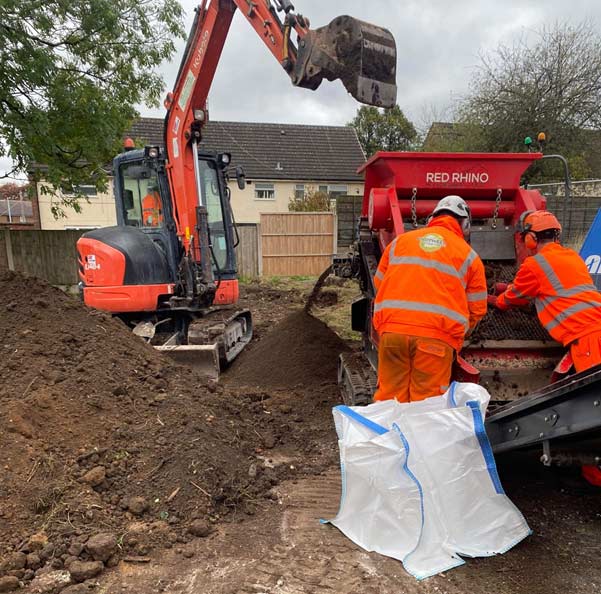
Using the screening method, the Japanese knotweed rhizome material is separated from the soil material. The Japanese knotweed material is then either transported to licensed landfill at a much lower disposal rate or incinerated on site using a D6 exemption from the Environment Agency or Natural Resources Wales.
The cleaned soils can then be reused in locations away from any construction, normally in soft landscaping areas.
This can reduce the landfill & backfill requirement costs significantly and can also help to reduce the carbon footprint on site due to reduced vehicle movements to landfill.

BIOSECURITY SUPERVISION
We can provide a biosecurity operative to monitor any excavations or movement of Japanese knotweed-containing soil on your property.
As part of these measures, we can set up a place at the entrance to the site where people can wash their boots and machines. We will provide all toolbox talks for the main contractor on site, which will be signed by all contractors involved in the operation on site.
We can provide temporary geotextile barriers in areas where biosecurity is required.
Once the work has been completed, we will provide the client with a full biosecurity report.
This method can be used in conjunction with other treatment methods on site.

EXCAVATION AND DISPOSAL
This treatment method is ideal where time constraints are present and there’s no other option other than to remove both the Japanese Knotweed and contaminated soil to a registered landfill.
By removing all traces of the infestation quickly, this offers a rapid solution to your problem and allows your commercial project to begin groundwork’s almost straight away. When time is of the essence, there is no quicker Japanese Knotweed removal/treatment method.
Any waste taken off-site will be done so with a licensed waste carrier to a suitably authorised landfill site.

CELL BURIAL
Cell burial comprises of moving Knotweed contaminated soil from one location on site, burying it in an excavated pit which is lined with a root barrier membrane, in a different position on the site.
The burial requirements for Japanese Knotweed are as follows:
- The Environment Agency recommends that the top of the burial cell should be a minimum of 2 metres below ground level.
- The overall depth of the burial pit should be in excess of 5 metres deep. All root barrier seams are welded together forming an encapsulated cell from which the Japanese Knotweed cannot escape. Clean soil is then used to backfill on top of the cell.
- To prevent accidental disturbance of the burial site, it is recorded on all site plans and future land owners should be made aware of the location.

STOCKPILE & TREAT
Japanese knotweed-contaminated soil can be moved to another portion of the site being treated using a technique called bunding. A bund is a patch of polluted soil that is only a few metres deep.
To make the surface flush with the surroundings, the bund can either be lifted, placed on top of the land, or positioned inside an excavation.
The bund’s function is to relocate the Japanese knotweed to an inactive portion of the land. The Japanese knotweed may now be treated, which would not have been possible in its original location.

HERBICIDE APPLICATION
At Knotweed Services we can provide the client with bespoke treatment plans depending on the locations of the Japanese knotweed.
These plans can work in conjunction with other methods of treatment where access is limited to pedestrian movements i.e., embankments or existing pathways within a site.
This will normally consist of up to 3 visits per annum to apply herbicide by either foliar spray technique or stem injection during the growing season over a period of 3 years, with a monitoring period of 2 years thereafter.
We would select the appropriate herbicides depending on the surrounding foliage or environmental constraints.
After each visit a full treatment record would be provided with photos showing the progress of the works and then an annual report.
AVAILABLE THROUGHOUT Cheshire
- Ellesmere Port
- Farnworth
- Frodsham
- Grappenhall
- Great Sankey
- Handforth
- Hartford
- Haslington
- Holmes Chapel
- Hoole
- Knutsford
- Lache
- Latchford
- Lymm
- Macclesfield
- Swanley
- Upton
- Vicarscross
- Warrington
- Weaverham
- Westbrook
- Westy
- Wharton
- Whitby
- Widnes
- Wilmslow
- Winsford
- Wistaston
- Woolston